Lampposted
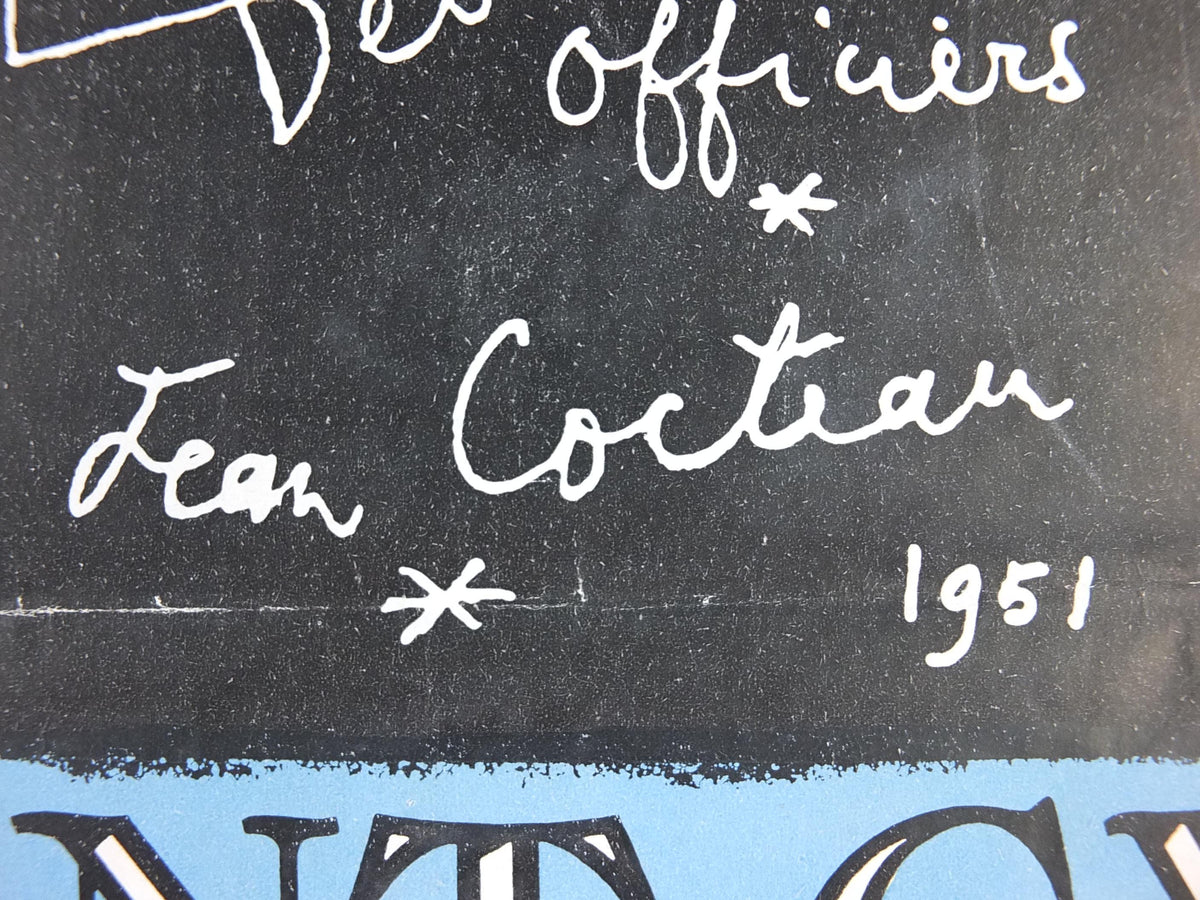
1951 Jean Cocteau Poster, The Triumph of Saint-Cyr 1951, Promotion du Garigliano, surrealist avant-garde Dada, exhibition wall art decor
1951 Jean Cocteau Poster, The Triumph of Saint-Cyr 1951, Promotion du Garigliano, surrealist avant-garde Dada, exhibition wall art decor
Size: 51 cm x 66 cm
Condition: Some light fold marks, some rough edges, some edge marks, see photos.
Couldn't load pickup availability
1951 Jean Cocteau Poster, The Triumph of Saint-Cyr 1951, Promotion du Garigliano, surrealist avant-garde Dada, exhibition wall art decor
This original pale blue Jean Cocteau exhibition poster celebrates the Triumph of Saint-Cyr ceremony from 1951. "Triomphe de Saint-Cyr - Promotion du Garigliano - 29 juillet 1951 à Saint-Cyr - Coëtquidan - Morbihan".
Imprimé par "Les Nouvelles", Rennes.
The poster has written words "Honneur à Saint-Cyr - Sans le cérémonial, tout meurt - A genoux les hommes, debout les officiers." or "Honor to Saint-Cyr - Without the ceremony, everything dies - On your knees the men, standing the officers".
Dimensions: 26 in x 20 in (66 cm x 51 cm)
Condition: some light fold marks, some rough edges, some edge marks, see photos.
Jean Cocteau was a French poet, playwright, novelist, designer, filmmaker, visual artist and critic. He was one of the foremost creatives of the surrealist, avant-garde, and Dadaist movements; and one of the most influential figures in early 20th-century art as a whole. The National Observer suggested that, “of the artistic generation whose daring gave birth to Twentieth Century Art, Cocteau came closest to being a Renaissance man.”
Though his body of work encompassed many different mediums, Cocteau insisted on calling himself a poet, classifying the great variety of his works – poems, novels, plays, essays, drawings, films – as "poésie", "poésie de roman", "poésie de thêatre", "poésie critique", "poésie graphique" and "poésie cinématographique".
The École spéciale militaire de Saint-Cyr (Special Military School of Saint-Cyr) is a French military academy. It is located in Coëtquidan in Guer, Morbihan, Brittany. Its motto is Ils s'instruisent pour vaincre, literally meaning "They study to vanquish" or, more freely put, "Training for victory". French cadet officers are called saint-cyriens or cyrards.
The academy was founded in Fontainebleau in 1802 by Napoleon. It was moved in 1806 to the buildings of the former Maison Royale de Saint-Louis, in Saint-Cyr-l'École, west of Paris. During the Second World War, the cadets moved several times due to the German invasion. They eventually settled in 1945 in the Coëtquidan military camp in Morbihan.
At the Saint-Cyr Coëtquidan military school (AMSCC), the Triumph ceremony marks the end of the schooling of the student officers of the special military school (ESM), the combined arms military school (EMIA) and the military aspirant school (EMAC) each year in July. It is also an opportunity for the officers of the specialties (ODS) to receive their stripes and the name of the new promotion of the ESM. For two days, the AMSCC also organizes the International Military Book Festival and allows the public to meet new authors. In the evening, the ceremony is presided over by the highest civil and military authorities.
What is special about exhibition and gallery posters is that they are an affordable way of getting good, unique art on the walls, as although it is not an artists original, neither is it something that has been mass reproduced.
He is best known for his novels Le Grand Écart (1923), Le Livre Blanc (1928), and Les Enfants Terribles (1929); the stage plays La Voix Humaine (1930), La Machine Infernale (1934), Les Parents terribles (1938), La Machine à écrire (1941), and L'Aigle à deux têtes (1946); and the films The Blood of a Poet (1930), Les Parents Terribles (1948), Beauty and the Beast (1946), Orpheus (1950), and Testament of Orpheus (1960), which alongside Blood of a Poet and Orpheus constitute the so-called Orphic Trilogy. He was described as "one of [the] avant-garde's most successful and influential filmmakers" by AllMovie. Cocteau, according to Annette Insdorf, “left behind a body of work unequalled for its variety of artistic expression.”
Because of the age of these posters, there are areas of wear and tear, particularly on the edges. I have done my best to take photos where they are torn. The good news is that when framed, the tears press up well against glass, and edges can be hidden by mats. Any wear picked up from years are part of the charm.
These posters are sent as unframed. They are delivered in a cardboard tube for protection.
See the FAQ for more information on shipping, tracking and insurance options.
Era: 1950s
Share