Lampposted
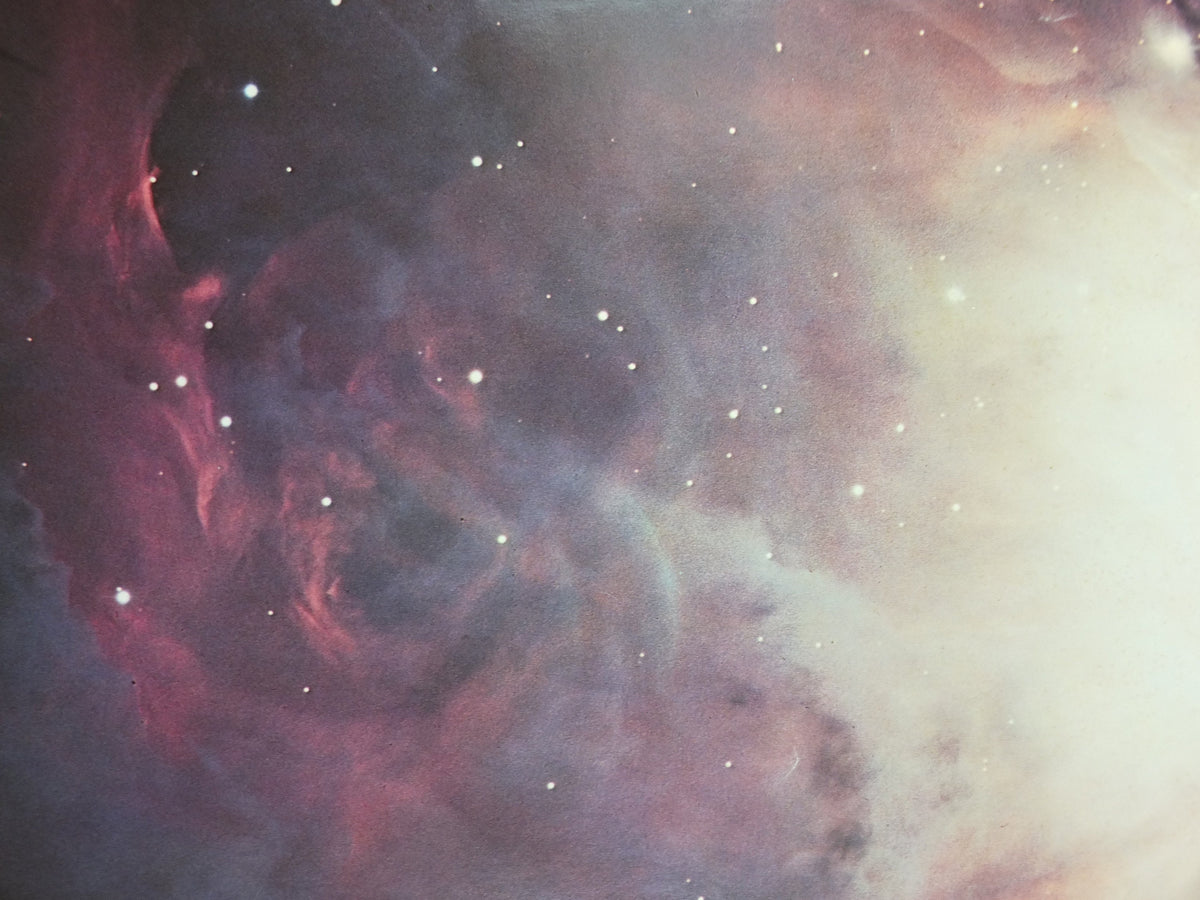
1959 Great Nebula in Orion Poster, NGC 1976 California Institute of Technology and Carnegie Institution, Hale Observatories, wall art decor
1959 Great Nebula in Orion Poster, NGC 1976 California Institute of Technology and Carnegie Institution, Hale Observatories, wall art decor
Size: 74 cm x 57 cm
Condition: Some foxing to the edges, see photos.
Couldn't load pickup availability
1959 Great Nebula in Orion Poster, NGC 1976 California Institute of Technology and Carnegie Institution, Hale Observatories, wall art decor
This is a poster of the Great Nebula in Orion from 1959. It's one of a series of posters from Caltech and CIS (Carnegie Institution for Science) in the 1950s and 1960s.
Printed by : California Institute of Technology and Carnegie Institution Washington
Images taken from the Hale Observatories with a 200 inch Hale Telescope
Printed in USA
Dimensions: 22.5 in x 29 in (57 cm x 74 cm)
Condition: some foxing to the edges, see photos.
The Orion Nebula (also known as Messier 42, M42, or NGC 1976) is a diffuse nebula situated in the Milky Way, being south of Orion's Belt in the constellation of Orion. It is one of the brightest nebulae and is visible to the naked eye in the night sky with apparent magnitude 4.0. It is 1,344 ± 20 light-years (412.1 ± 6.1 pc) away and is the closest region of massive star formation to Earth. The M42 nebula is estimated to be 24 light-years across (so its apparent size from Earth is approximately 1 degree). It has a mass of about 2,000 times that of the Sun. Older texts frequently refer to the Orion Nebula as the Great Nebula in Orion or the Great Orion Nebula.
The Orion Nebula is one of the most scrutinized and photographed objects in the night sky and is among the most intensely studied celestial features. The nebula has revealed much about the process of how stars and planetary systems are formed from collapsing clouds of gas and dust. Astronomers have directly observed protoplanetary disks and brown dwarfs within the nebula, intense and turbulent motions of the gas, and the photo-ionizing effects of massive nearby stars in the nebula.
Because of the age of these posters, there are areas of wear and tear, particularly on the edges. I have done my best to take photos where they are torn or stained. The good news is that when framed, the tears press up well against glass, and edges can be hidden by mats. Any wear picked up from years are part of the vintage charm.
These posters are sent as unframed. They will be rolled up and delivered in a cardboard tube for protection.
See the FAQ section for more information on shipping, tracking and insurance.
Era: 1950s
Share