Lampposted
1969 Australia Outback Poster, A bush picnic and BBQ at the Ross River Cattle Station Resort, great outdoors travel & tourism wall art decor
1969 Australia Outback Poster, A bush picnic and BBQ at the Ross River Cattle Station Resort, great outdoors travel & tourism wall art decor
Size: 64 cm x 102 cm
Condition: Excellent vintage quality, see photos for detail
Couldn't load pickup availability
This is an original Australia travel poster of The Outback. Advertised as "A bush picnic at the Ross River Cattle Station Resort" it shows a barbecue taking place after what looks like a hard day of cattle riding int the greeat Australian outback.
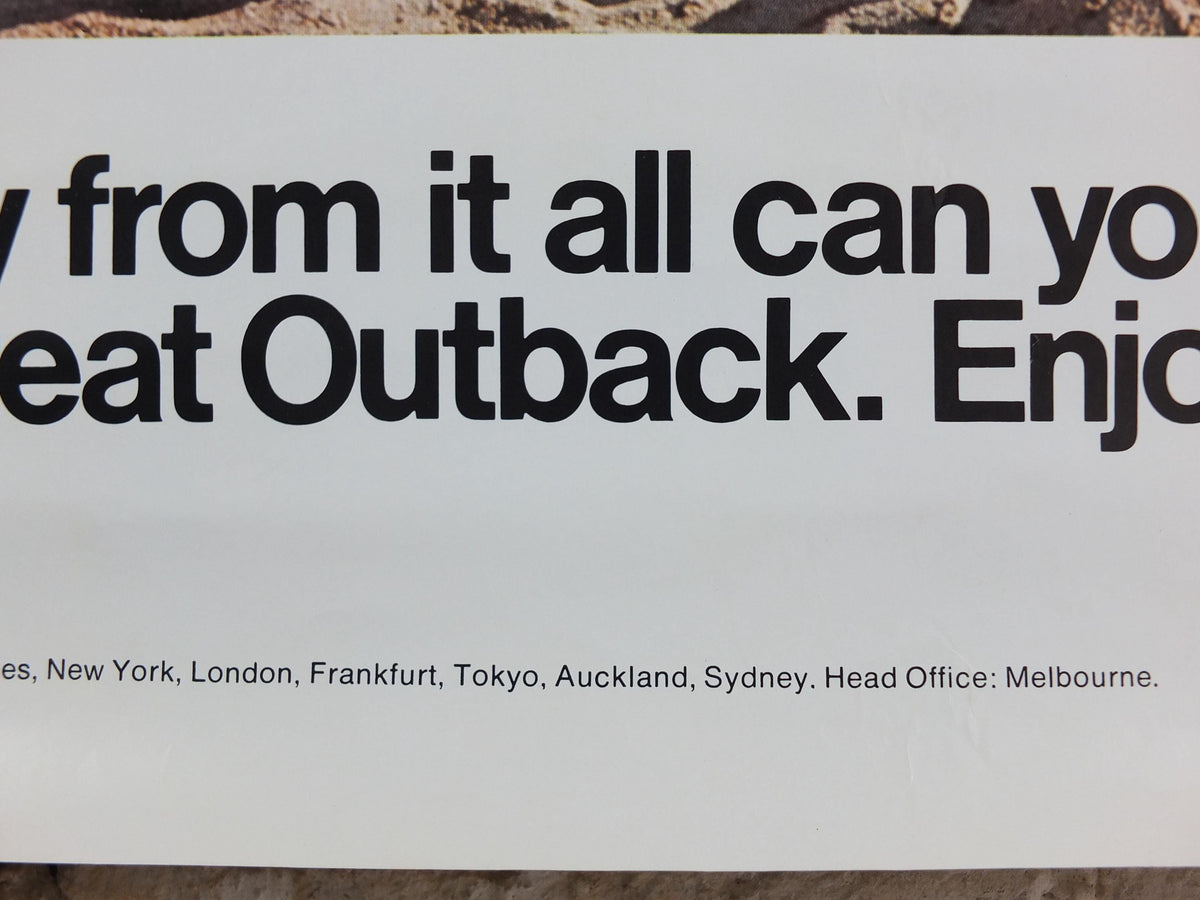
"How far away from it all can you get? Australia's Great Outback Enjoy it with us"
Printed by the Australian Tourist Commission.
Printed in Australia
Dimensions: 40 in x 25 in (102 cm x 64 cm)
The Outback is a remote, vast, sparsely populated area of Australia. The Outback is more remote than the bush. While often envisaged as being arid, the Outback regions extend from the northern to southern Australian coastlines and encompass a number of climatic zones, including tropical and monsoonal climates in northern areas, arid areas in the "red centre" and semi-arid and temperate climates in southerly regions. Geographically, the Outback is unified by a combination of factors, most notably a low human population density, a largely intact natural environment and, in many places, low-intensity land uses, such as pastoralism (livestock grazing) in which production is reliant on the natural environment. The Outback is deeply ingrained in Australian heritage, history and folklore.
Ross River Homestead is situated 83 km by sealed road, East North East of Alice Springs and offers a taste of the Australian outback's pioneering history. It is a tourist resort formed around the original Loves Creek Homestead built in the 1890's, and was first established as an outstation of Undoolya Station. The Macdonnell Ranges were recognised as premium horse-breeding country as the stony and sandy terrain helped to develop well formed feet in horses. The breed often referred to as "Waler's" were breed here and were renowned for their endurance. After Lewis Bloomfield died in 1944, his son Harry and wife Mary continued to run the station, moving to outstations of Atnarpa and Limbla during their lifetime. Two brothers Doug and Gil Green from Adelaide were working in Central Australia as timber cutters and in 1957 negotiated with Harry Bloomfield to take on what is the current day Ross River and developed it as a tourist destination. The homestead was badly deteriorated and it took the Green brothers seven years to rebuild the old homestead and construct the rustic en-suite accommodation cabins.
Because of the age of these posters, there are areas of wear and tear, particularly on the edges. I have done my best to take photos where they are torn. The good news is that when framed, the tears press up well against glass, and edges can be hidden by mats. Any wear picked up from years are part of the charm.
When framed these colourful and detailed posters can become a centre piece for any room, to remind us of a simpler time.
These posters are sent as unframed. They will be rolled up and delivered in a cardboard tube for protection.
See the FAQ for more information on shipping, tracking and insurance options.
Era: 1960s
Share