Lampposted
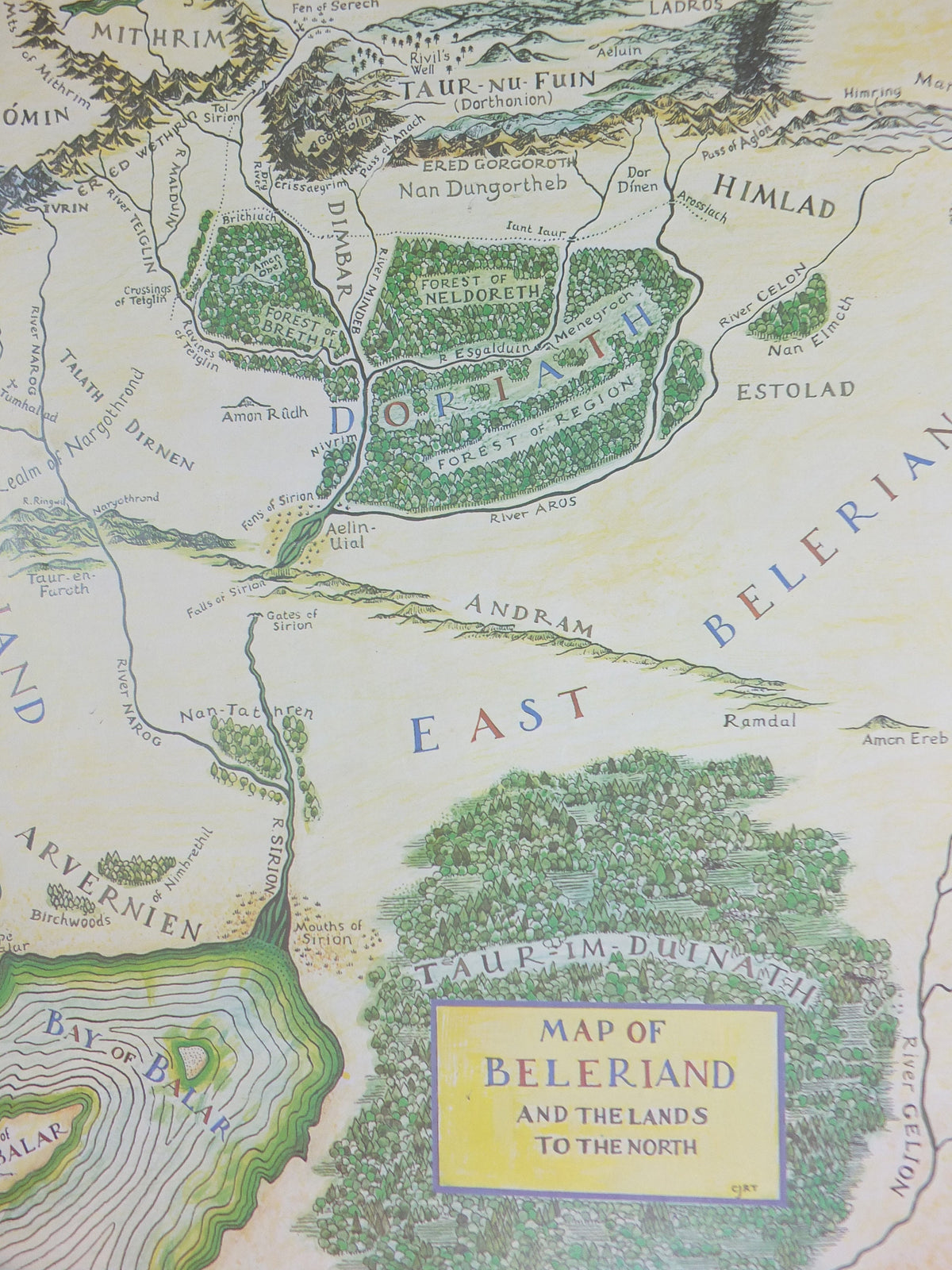
1979 Original Vintage J.R.R. Tolkien Map of Beleriand, Middle Earth Poster by Christopher Tolkien, Gondolin, fantasy fiction, wall art decor
1979 Original Vintage J.R.R. Tolkien Map of Beleriand, Middle Earth Poster by Christopher Tolkien, Gondolin, fantasy fiction, wall art decor
Size: 51 cm x 76 cm
Condition: Pinholes, see photos.
Couldn't load pickup availability
1979 Original Vintage J.R.R. Tolkien Map of Beleriand, Middle Earth Poster by Christopher Tolkien, Gondolin, fantasy fiction, wall art decor
This is a 1979 map of J.R.R Tolkien's "Map of the Beleriand - and the lands to the North" from the fantasy world of Middle Earth. It shows the heraldry of 14 of the Eldar on the top and bottom of the map. Printed in Great Britain by Henry Stone and Sons, Banbury, Oxfordshire.
Second impression from 1979 from George Allen & Unwin
Publishers: George, Allen, & Unwin
Printers: Printed in Great Britain by Henry Stone & Sons, Banbury, England
Dimensions: 30 in x 20 in (76cm x 51 cm)
Condition: Pinholes, see photos.
Text reads: Emblems by J.R.R. Tolkien. Copyright George, Allen, & Unwin (Publishers) Ltd 1973 1978. Map drawn by Christopher Tolkien, coloured by H.R. Riddett. C George, Allen, & Unwin (Publishers) Ltd 1977 1978. Second Impression 1979. Printed in Great Britain by Henry Stone & Sons (Printers) Ltd Banbury.
Beleriand was a vast region located in north-western Middle-earth during the First Age. Originally, its name referred only to the area around the Bay of Balar, but in time the name was also applied to the entire land. The root of the word, Beler or Balar, is believed to refer to the Maia Ossë, who often dwelt at the shores of Balar. The War of Wrath at the end of the First Age brought the destruction of the entire continent (except Lindon), and its descent into the sea.
To the west and south, Beleriand had a long coast with the Great Sea Belegaer; to the north were the highland regions of Hithlum, Dorthonion, and the hills of Himring; to the east the Blue Mountains reached nearly to the sea. The land of Nevrast in the north-west was sometimes considered part of Beleriand.
Sirion, the chief river of Beleriand, running north to south, divided the continent into West Beleriand and East Beleriand. Crossing it east to west was a series of hills and a sudden drop in elevation known as Andram, the Long Wall. (The river sank into the ground at the Fens of Sirion, and reemerged below the Andram at the Gates of Sirion.) To the east of the Long Wall, was the River Gelion with its six tributaries draining the Blue Mountains, in an area known as Ossiriand or the Land of Seven Rivers. The River Brithon and the River Nenning were the two lesser rivers of the western land of Falas.
In the year FA 583, Beleriand was mostly destroyed by the War of Wrath of the Valar against Morgoth. Only a small section of East Beleriand remained, and was known as Lindon. In addition, fulfilling a prophecy, the graves of Túrin Turambar and Morwen also survived as the island Tol Morwen. Part of Dorthonion became Tol Fuin, and the Hill of Himring became the island of Himling. All of these together were known as the Western Isles.
The name Beleriand refers either to the continent's initial colonization by the Teleri who had been ferried to Beleriand upon the Isle of Balar, or to the land's great Bay of Balar in accordance with the name's meaning, "land of Balar".
Beleriand had many emended different names in Tolkien's earlier writings: Broceliand, Broseliand, Golodhinand, Noldórinan, Geleriand, Bladorinand, Belaurien, Arsiriand, Lassiriand, and Ossiriand (which was later used as a name for another realm).
Because of the age of these posters, there are areas of wear and tear, particularly on the edges. I have done my best to take photos where they are torn. The good news is that when framed, the tears press up well against glass, and edges can be hidden by mats. Any wear picked up from years are part of the charm.
When framed these colourful and detailed posters can become a centre piece for any room, to remind us of a simpler time.
These posters are sent as unframed. They will be rolled up and delivered in a cardboard tube for protection.
See the FAQ for more information on shipping, tracking and insurance options.
Era: 1970s
Share