Lampposted
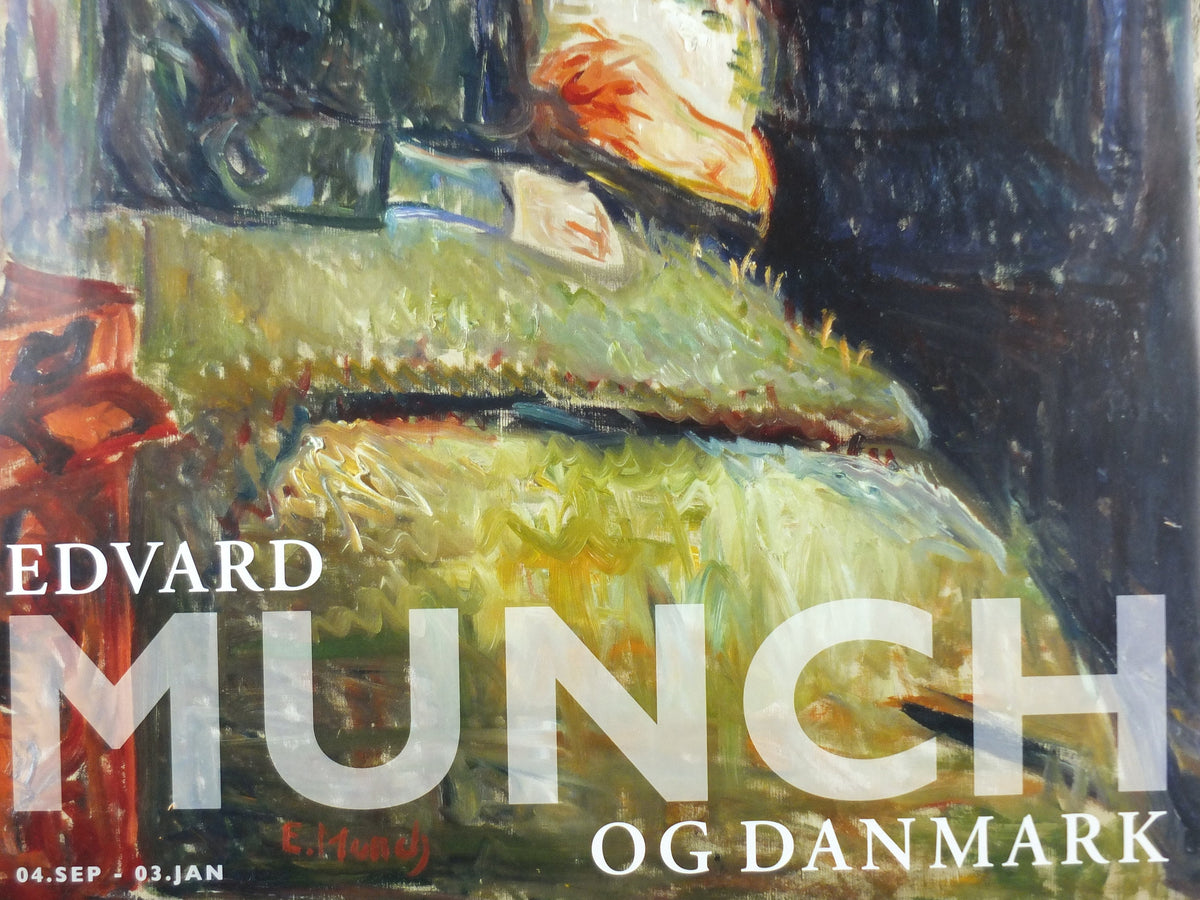
Edvard Munch Poster, The Sick Child, Ordrupgaard, Expressionism, Symbolism, Det syke barn, gallery exhibition, wall art decor
Edvard Munch Poster, The Sick Child, Ordrupgaard, Expressionism, Symbolism, Det syke barn, gallery exhibition, wall art decor
Size: 60 cm x 84 cm
Condition: Slight marks bottom edge, see photos.
Couldn't load pickup availability
This original Edvard Munch exhibition poster is from the Ordrupgaard in Copenhagen, Denmark, for a 1990s exhibition featuring "The Sick Child" from 1885 / 1926. The exhibition is about Munch in Denmark.
Dimensions: 33 in x 23.5 in (84 cm x 60 cm)
Condition: slight marks bottom edge, see photos.
The Sick Child is the title given to a group of six paintings and a number of lithographs, drypoints and etchings completed by the Norwegian artist Edvard Munch between 1885 and 1926. All record a moment before the death of his older sister Johanne Sophie from tuberculosis at 15. Munch returned to this deeply traumatic event repeatedly in his art over a period of more than 40 years. In the works, Sophie is typically shown on her deathbed accompanied by a dark-haired, grieving woman assumed to be her aunt Karen; the studies often show her in a cropped head shot. In all the painted versions Sophie is sitting in a chair, obviously suffering from pain, propped by a large white pillow, looking towards an ominous curtain likely intended as a symbol of death. She is shown with a haunted expression, clutching hands with a grief-stricken older woman who seems to want to comfort her but whose head is bowed as if she cannot bear to look the younger girl in the eye.
Edvard Munch was a Norwegian painter. His best known work, The Scream, has become one of the iconic images of world art. Studying at the Royal School of Art and Design in Kristiania (today's Oslo), Munch began to live a bohemian life under the influence of the nihilist Hans Jæger, who urged him to paint his own emotional and psychological state ('soul painting'). From this emerged his distinctive style.
What is special about exhibition and gallery posters is that they are an affordable way of getting good, unique art on the walls, as although it is not an artists original, neither is it something that has been mass reproduced.
Because of the age of these posters, there are areas of wear and tear, particularly on the edges. I have done my best to take photos where they are torn. The good news is that when framed, the tears press up well against glass, and edges can be hidden by mats. Any wear picked up from years are part of the charm.
These posters are sent as unframed. They are delivered in a cardboard tube for protection.
See the FAQ for more information on shipping, tracking and insurance options.
Era: Unknown
Share